
The PC era might be ending


If you're not already a subscriber of the marvellous BBC Archive YouTube channel, you should be—not least because of this gem from The Learning Zone they published a few weeks back showing a couple of families looking to buy their first personal computers.
It's unabashedly 90s, but a magnificent look back to a world at the cusp of technology's biggest revolution. 32MB RAM! Windows 95! Calling the PC a "hard drive"! It's all there.
In the nearly 30 years that have passed, things have changed. A lot. One of the families in the programme mentions a budget of around £1,000 for their entire setup (that's around £2,000 today) for general home use, whereas today we're used to more affordable PCs with capabilities far exceeding anything from that era.
At the other end of the spectrum, hobbyists have been building their own PCs for far longer, selecting their own components to meet their own needs. In many cases, these are at the higher-end of the market, with specifications and designs typically unappealing to the mainstream but very much coveted by enthusiasts.
And in recent years, it's usually been the case that powerful home computing has become increasingly accessible. But for the first time in the PC's history, it's starting to look like that may no longer be the case.
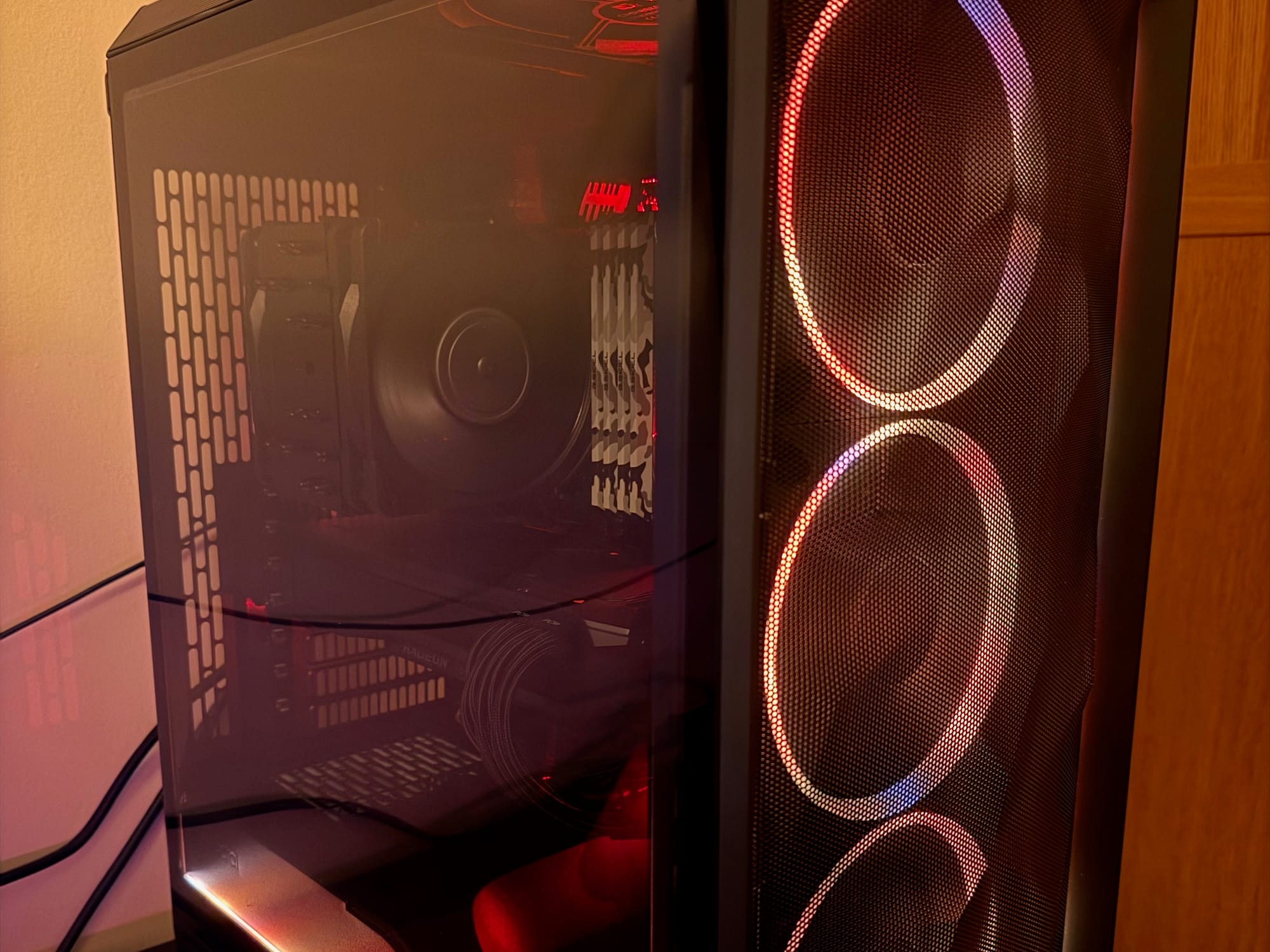
What's happened?
Spoiler alert: yes, it's AI.
ChatGPT launched back in 2022 and set off a proverbial rocket in the tech industry, attracting the most significant mainstream attention the industry has had since the smartphone era. To say investors have been excited about it would be quite the understatement.
 Luke Kawa
As excitement for AI (specifically transformer-based deep learning and LLMs) has swelled, major players have been buying up as much computing resources as they can as part of a broader 'race' to achieve AGI (artificial general intelligence). Fundamentally, this has manifested through announcements for massive data centre projects and supercomputers to aspire to this vision, yet simultaneously reorienting the tech sector's focus to such an extent that consumers are finding themselves squeezed out.
This is happening because every data centre and supercomputing project out there uses some form of the same core components that the traditional home computer always has done. CPUs (Central Processing Units) have long been at the heart of data centres—but as demand has intensified for more power, typically that associated with generative AI, the spotlight has increasingly turned to GPUs (Graphics Processing Units).
GPUs are specialised processors traditionally designed to render digital images far more efficiently and effectively than a CPU, owing to their unique architectural approach to perform far more simultaneous computations than a CPU, albeit each one less powerfully. Historically, this has made them highly adept at rendering complex digital images for films and real-time worlds for games. Because of their approach to performing complex parallel computations, it's made them invaluable for workloads like scientific research, cryptocurrency mining, and deep learning.
It's for this reason that GPU demand has soared in the last few years, as the tech sector has gone all-in on AI. Around this time five years ago, Nvidia (whose business is largely built on GPUs) reported first quarter revenues for its consumer and gaming business of $1.34 billion, with data centre at $1.14 billion. Just a few weeks ago, it reported $75.2 billion data centre revenue for the first quarter of fiscal 2027, with the consumer and gaming business now folded under the much broader 'edge computing' category.
Micron, one of the world's primary suppliers of computer memory (and suppliers to GPU manufacturers that rely on fast, abundant memory for AI workloads performed on their processors) similarly announced record results this past week against soaring demand, whilst locking in 16 long-term customer deals across the next 5 years.
What could happen next?
The ripple effects of the AI boom have been nothing short of immense on the rest of the tech world. It's not just GPUs and memory. Pretty much every component you can imagine a modern computer needs, whether it's your laptop at home or the smartphone in your pocket, is experiencing this crunch. Storage devices like SSDs and HDDs. Power supplies too. Even the printed circuit boards at the foundational core of all of this are constrained.
The implications for all of this are becoming increasingly clear. Packaged products are increasing in price—everything from laptops and desktops, to game consoles and smartphones. Consequently, sales are stalling.
 Liv McMahon
But arguably the more concerning story is that of the PC enthusiast; the hobbyist who bought and traded these core components to build and upgrade their own system. Prices for these components have increased at eye-watering levels to the extent that even the concept of an 'entry-level PC' is something of a misnomer now.
The way things are headed, we may be approaching a world where the concept of building or buying your own PC could be a thing of the past and you might, instead, have a low-power device at home and a subscription to access a PC 'in the cloud'.
People have been talking of a 'post-PC world' for many, many years now but so far they've never left us. They've always been there—and whilst many may have embraced the smartphone for everyday use, it's the PC that has brought fun to people's lives, or given people the power to learn new skills and bring their imaginations to life.
Looking back at that BBC Archive video, it really is incredible to pause and reflect on how far we've come, and the amazing things today's PCs can do; as Dave Green dubs them, "those odd white boxes that we've all invited into our lives". For decades, PCs have been there to empower humans to do the most incredible things. I just hope our industry never loses sight of that.